 Nextra
News20 Nov 2026
The decision API in Rhino, measured against Luna, Sol, Haiku, Sonnet and Gemini: more right, faster, cheaper
We graded Nexiy’s assistant on 66 Rhino and Grasshopper requests against nine chat models. Quick mode with a decision model got up to 63 right in under half a second, for under a dollar per thousand requests; the best single call (Claude Sonnet) got 58 at $26.63.
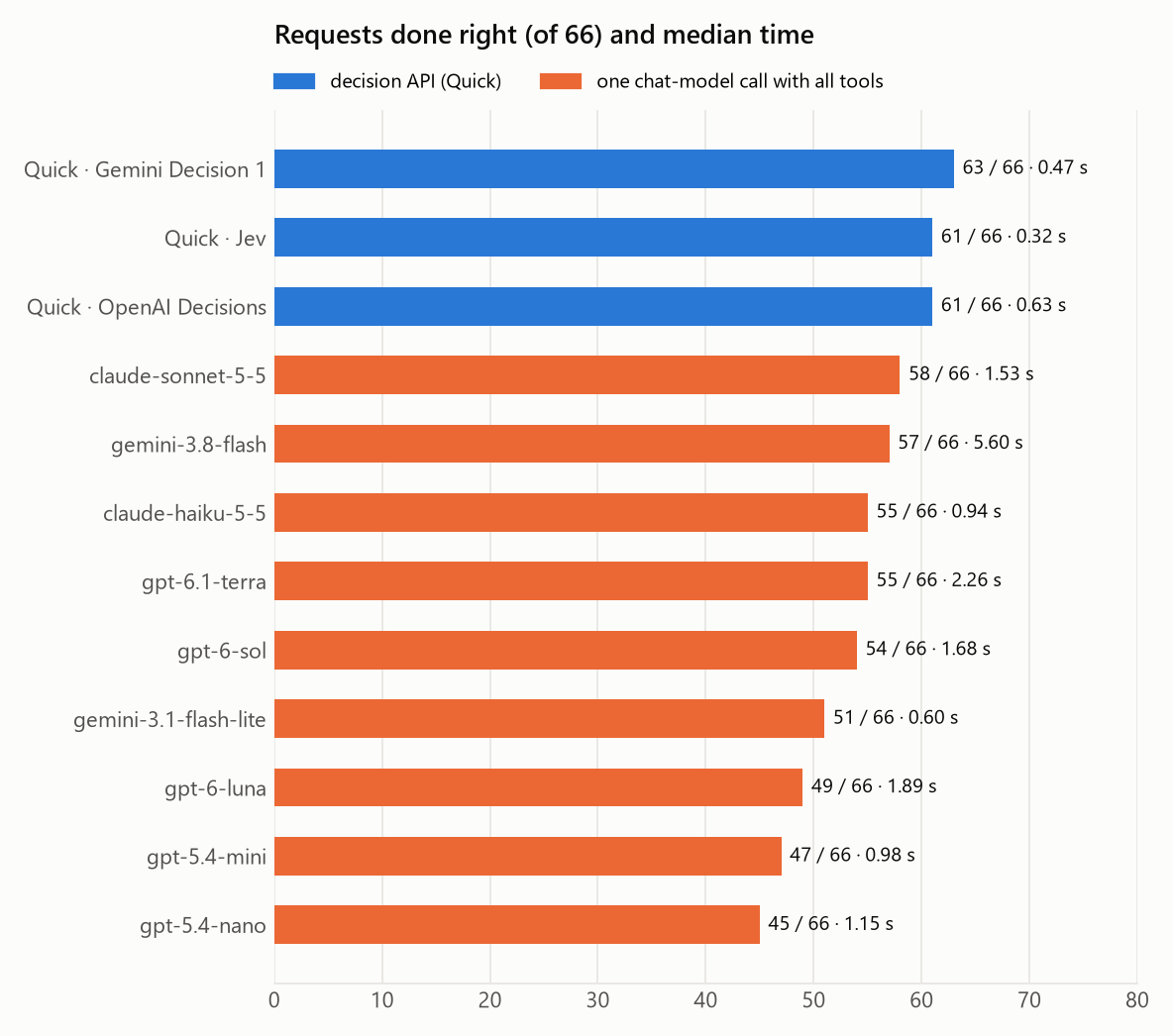
Nexiy's assistant in Rhino has two ways to work. Quick lets a decision model pick one of more than 60 typed Rhino and Grasshopper functions and fill in its values. LLM lets a chat model plan with every tool. We measured both, and compared Quick with the usual way to build an assistant: one call to a chat model that gets every function as a tool.
#The test
A test model: a 3-storey massing with 12 columns and 3 slabs, sketch curves, two empty layers and a small Grasshopper definition. Then 66 requests in plain English, each graded by code: the right function, the right values and the right objects, or a question back when something was missing.
- Set A (30 requests) was used to improve the function descriptions.
- Set B (20 requests) was written at the same time and never tuned on.
- Set G (16 requests) is about the Grasshopper canvas: add a component, wire, set a slider, group, bake.
#Quick mode: three deciders
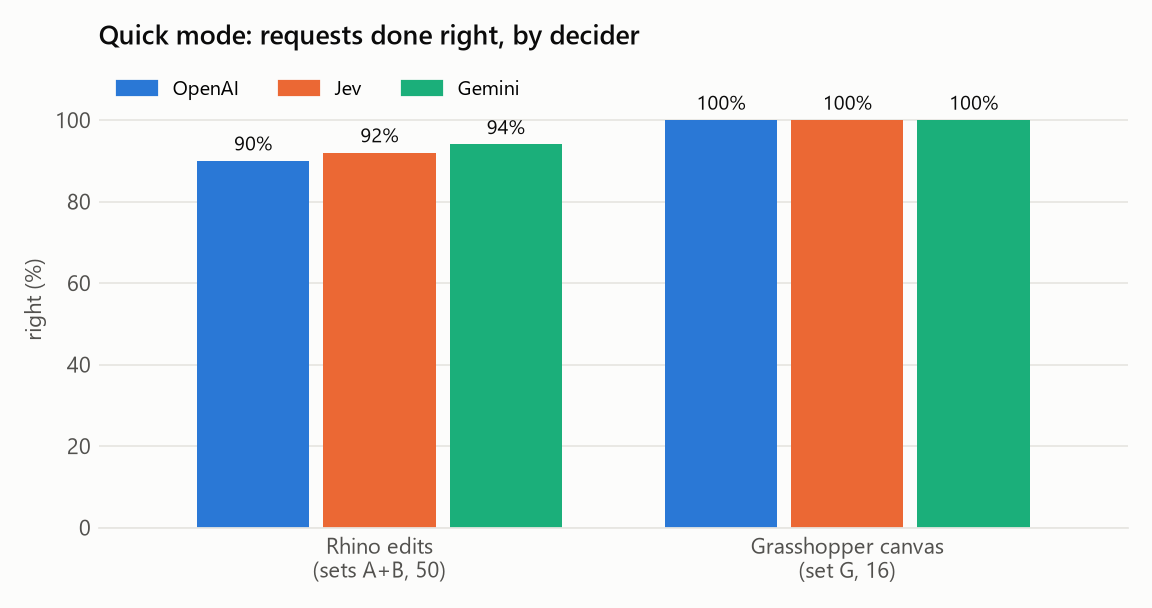
| Decider | All 66 | Rhino (A+B) | Grasshopper (G) | Median time | Decided without a chat model |
|---|---|---|---|---|---|
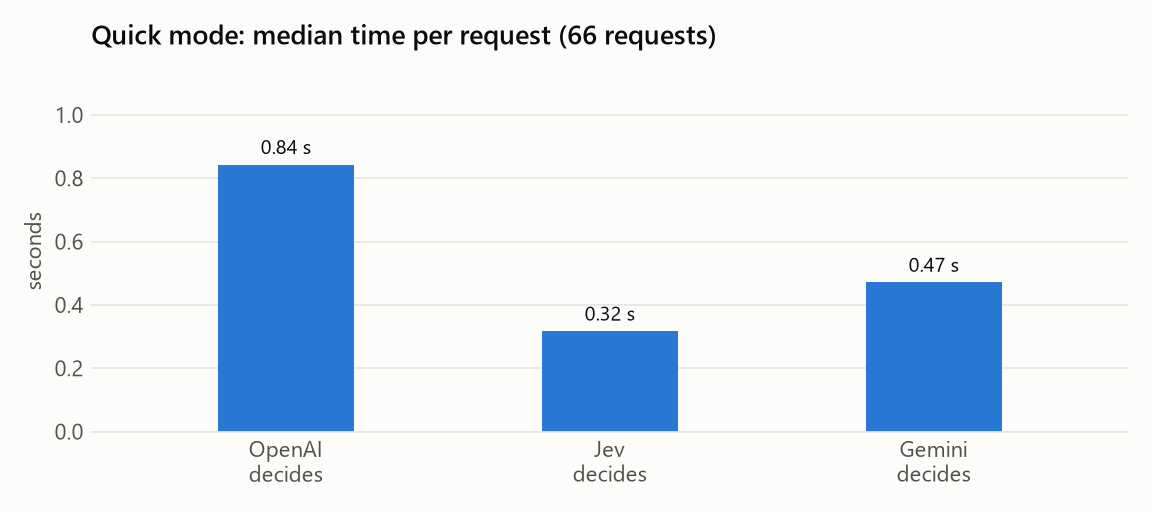
| OpenAI Decisions API | 61 | 45 / 50 | 16 / 16 | 0.63 s | 43 of 66 |
| Jev | 61 | 45 / 50 | 16 / 16 | 0.32 s | 44 of 66 |
| Gemini Decision 1 | 63 | 47 / 50 | 16 / 16 | 0.47 s | 56 of 66 |
#Compared with one call to a chat model
Same 66 requests, same functions, nine chat models from large to small (OpenAI Luna, Sol, Terra and GPT-5.4 mini and nano; Claude Sonnet and Haiku; Gemini 3.8 Flash and 3.1 Flash-Lite), each getting every function as a tool. Measured again on 20 November 2026, all set-ups on the same day:
| Set-up | Right (of 66) | Median time | Cost per 1,000 requests |
|---|---|---|---|
| Quick, Gemini Decision 1 | 63 | 0.47 s | $0.07 + the decision calls (no published price) |
| Quick, Jev | 61 | 0.32 s | $0.21 + the decision calls (no published price) |
| Quick, OpenAI Decisions API | 61 | 0.63 s | $0.72 |
| One call, claude-sonnet-5-5 | 58 | 1.53 s | $26.63 |
| One call, gemini-3.8-flash | 57 | 5.60 s | $6.00 |
| One call, claude-haiku-5-5 | 55 | 0.94 s | $1.34 |
| One call, gpt-6.1-terra | 55 | 2.26 s | $5.18 |
| One call, gpt-6-sol | 54 | 1.68 s | $10.32 |
| One call, gemini-3.1-flash-lite | 51 | 0.60 s | $2.01 |
| One call, gpt-6-luna | 49 | 1.89 s | $0.52 |
| One call, gpt-5.4-mini | 47 | 0.98 s | $3.90 |
| One call, gpt-5.4-nano | 45 | 1.15 s | $1.04 |
What it shows:
- More right, faster. The best single call (Claude Sonnet, 58) is still behind all three deciders, and every chat model takes longer than Quick with Jev or Gemini.
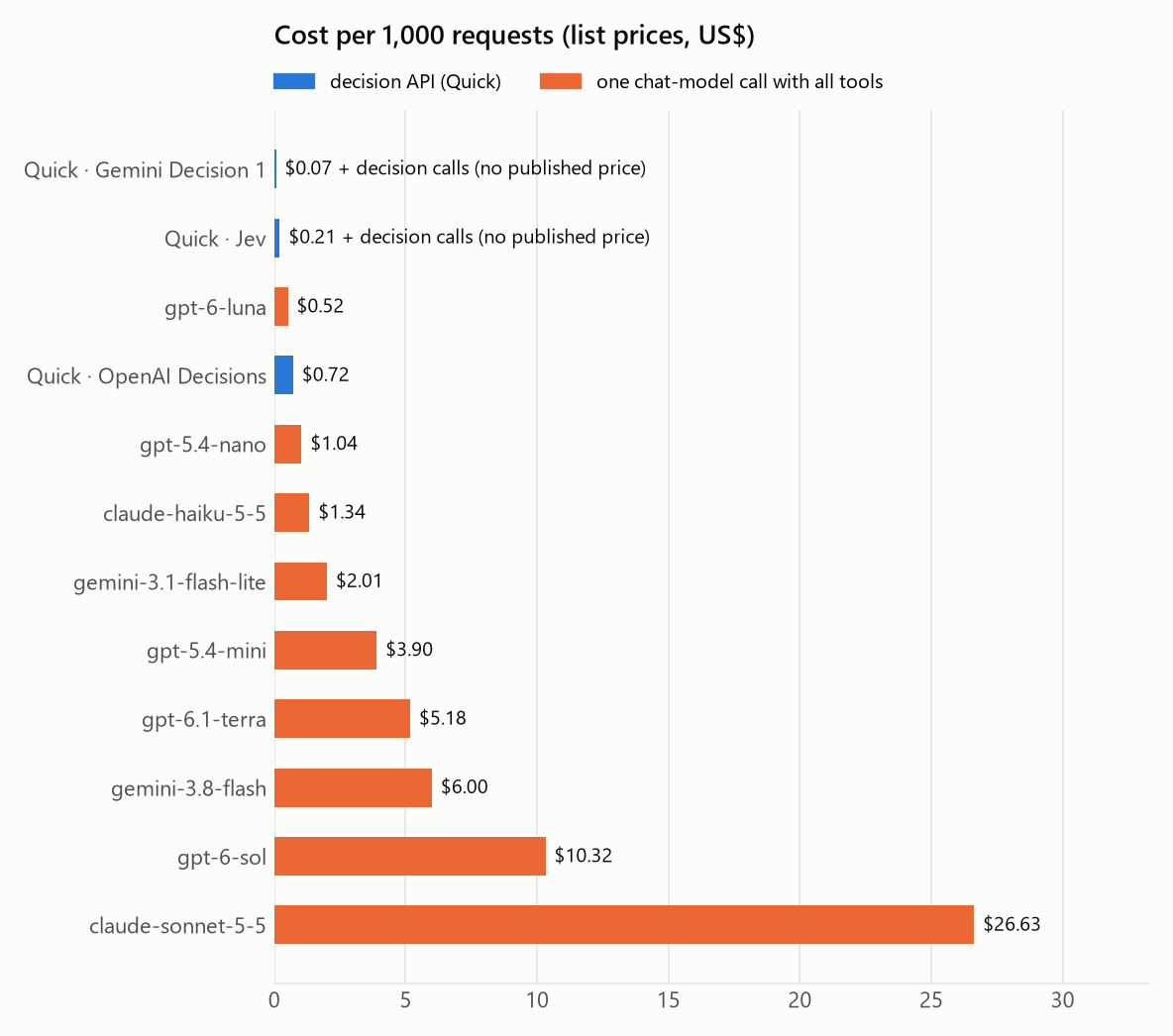
- Much cheaper. A single call sends every function along with every request: 5,000 to 13,000 tokens. Quick sends a few hundred to the decision model and calls a chat model only when it needs one. With OpenAI's prices, Quick costs $0.72 per thousand requests; one call to Claude Sonnet costs $26.63, to Sol $10.32.
- Grasshopper is where the decision API pulls ahead. Picking one of 3,228 installed components and the exact input to wire is a choice from a long list. Quick narrows it step by step and got all 16 Grasshopper requests; the chat models got 8 to 14.
- Small and cheap is not enough. gpt-6-luna as a single call is about as cheap as Quick ($0.52) but gets 49 of 66; as the decision model in Quick it gets 61.
Costs use the providers' list prices per million tokens in November 2026 (input / output: Luna $0.10 / $0.50, Sol $2 / $10, Terra $1 / $5, GPT-5.4 mini $0.75 / $4.50, nano $0.20 / $1.25, Claude Haiku 5.5 $0.10 / $0.50, Sonnet 5.5 $2 / $10, Gemini 3.8 Flash $0.75 / $3.75, 3.1 Flash-Lite $0.25 / $1.50), times the tokens each request really used. Jev and Gemini Decision 1 publish no per-token price yet, so their decision calls are not in the sum.
#LLM mode: multi-step work
We gave LLM mode 8 multi-step tasks, carried them out for real and checked the model afterwards: tidy the layers and move the sketch curves; copy the slabs up and lock the copies; set a slider and bake the result; a polar array around a point. With the OpenAI and the Gemini chat models, LLM mode completed 8 of 8, in a median of 9 s (OpenAI) and 16 s (Gemini) per task.
#What still goes wrong
- Words that are also layer names. Hide the columns, with a layer called Columns, can mean the objects or the layer. Naming one outright removes the doubt.
- Big workflows in one sentence (a 3-storey massing, 5 by 2 columns at 7.5 m) are often handed from Quick to LLM mode. That costs a few seconds, but the work gets done.
- Several Grasshopper definitions open: the assistant works on the active one.
#Which key?
- One key for everything: OpenAI.
- Fastest: Jev to decide, plus an OpenAI, Gemini or Claude key for LLM mode.
- Fewest chat-model calls: Gemini.
- No key at all for LLM mode: your own Claude Code, Codex or Gemini CLI (an example).
A decision costs a fraction of a cent. Our whole test series, several hundred requests across three providers, cost a few dollars.
Set it up: Set up Nexiy, the assistant in Rhino.
Measured in November 2026 on Rhino 8 for Windows, with the models named above. Results change with the models, the requests and the model you work on.