 Nextra
How-to7 Nov 2026
Claude or ChatGPT builds and designs it: Rhino, Grasshopper or both
The Nextra Design skill lets your AI app build the structural model, run the Eurocode design and show you the results, in Rhino, in Grasshopper or both at once. Tested with a small model.
Nextra Design checks structures to the Eurocodes inside Rhino 8. With the Nextra Design skill and the Nextra RhinoGh plug-in, Claude or ChatGPT can build the model for you, run the analysis and the design, and show you the results in Rhino. You ask in plain words; the AI does the clicks.
#Install in two minutes
- Install the Nextra RhinoGh plug-in for your AI app (install guide) and Nextra Design in Rhino.
- Download the skill ZIP and add it to your AI app: in Claude, Settings > Capabilities > Skills > upload; in ChatGPT, where your app lets you add skills.
- Open Rhino and ask.
#Three ways to build: Rhino, Grasshopper or both
| Mode | What it is | Good for |
|---|---|---|
| Rhino | members, supports and loads drawn in Rhino, with Nextra attributes | a fixed design, an existing structure, quick checks |
| Grasshopper | the Nx components, driven by sliders | anything you want to vary: span, height, roof shape |
| Both | the Grasshopper part and the Rhino part in one analysis | real buildings: some parts are fixed, some are parametric |
#Rhino: a timber beam from one request
You ask: In Rhino, make a timber floor beam: 5 m span, glulam GL24h 140x360, pinned and roller, permanent 1.5 kN/m and imposed (category A) 2.0 kN/m. Run the analysis and the design and tell me the utilisation.
The AI draws the line and the supports, writes the attributes, reads them back, runs, and answers: u 0.36, governed by the net final deflection; bending with lateral torsional buckling 0.317. We checked it by hand:
| Value | Nextra Design | Hand calculation |
|---|---|---|
| Bending + LTB (EN 1990 6.10b) | 0.317 | 0.317 |
| Instantaneous deflection | 5.24 mm | 5.25 mm |
| Net final deflection | 7.20 mm | 7.21 mm |
#Grasshopper: a parametric portal frame
You ask: In Grasshopper, build a parametric steel portal frame: span 6 m and height 4 m as sliders, HEA200 columns, IPE300 beam, fixed bases, permanent 5 kN/m and imposed 8 kN/m. Analyse and design it.
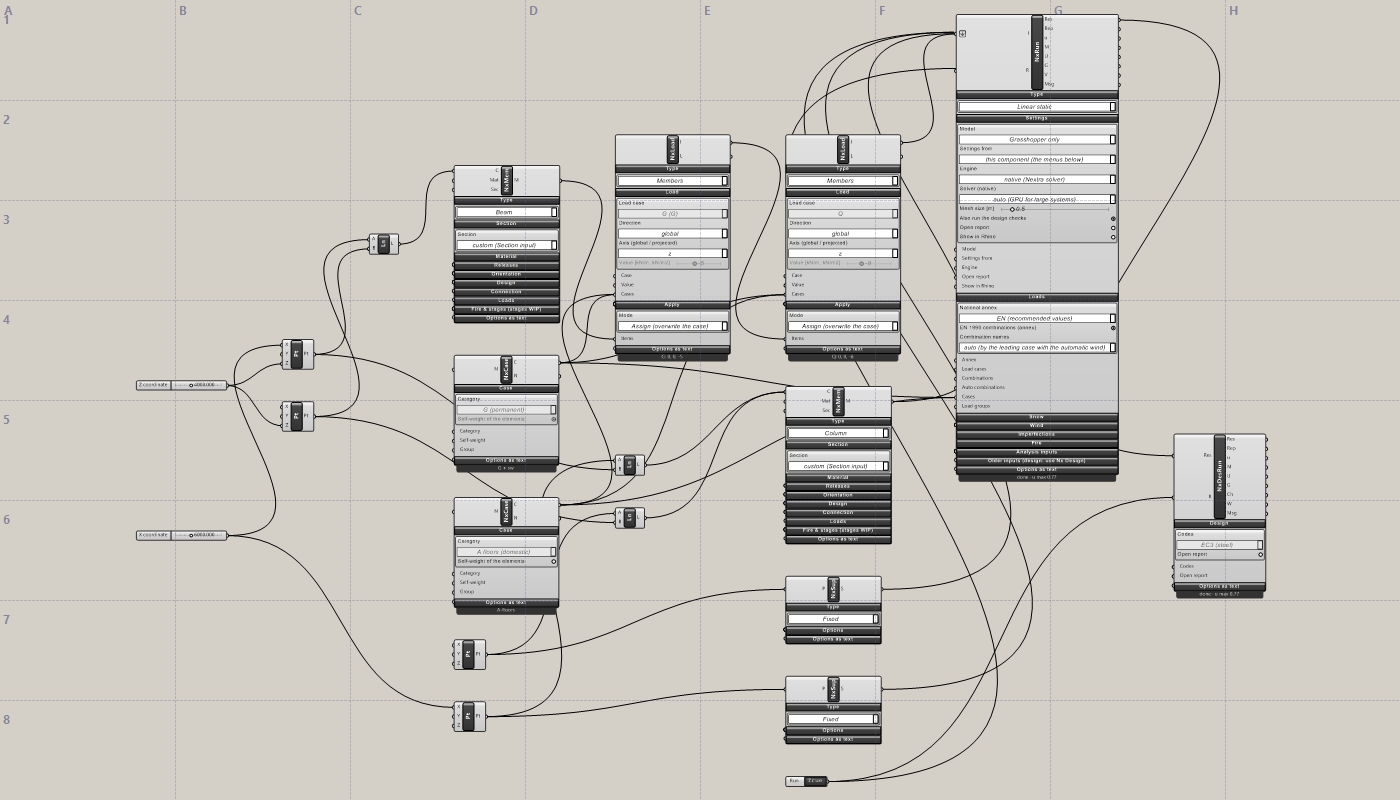
One edit builds the whole definition, from the sliders on the left to the design on the right: u max 0.77, the beam, member buckling with lateral torsional buckling. The same frame built in Rhino gives 0.771, the same answer.
#Both: the fixed part in Rhino, the parametric part in Grasshopper
This is the one we like most. A building is rarely all parametric: a core, an existing frame or a bay that will not change is drawn once in Rhino, and the part you are still designing lives in Grasshopper on sliders. Both analyses them as one structure, so when you move a slider, the fixed part takes its share.
You ask: The portal in Grasshopper is the parametric part. Next to it, draw a fixed second bay in Rhino: a column at 12 m and a beam from the portal's corner, same sections and loads. Analyse the two together.
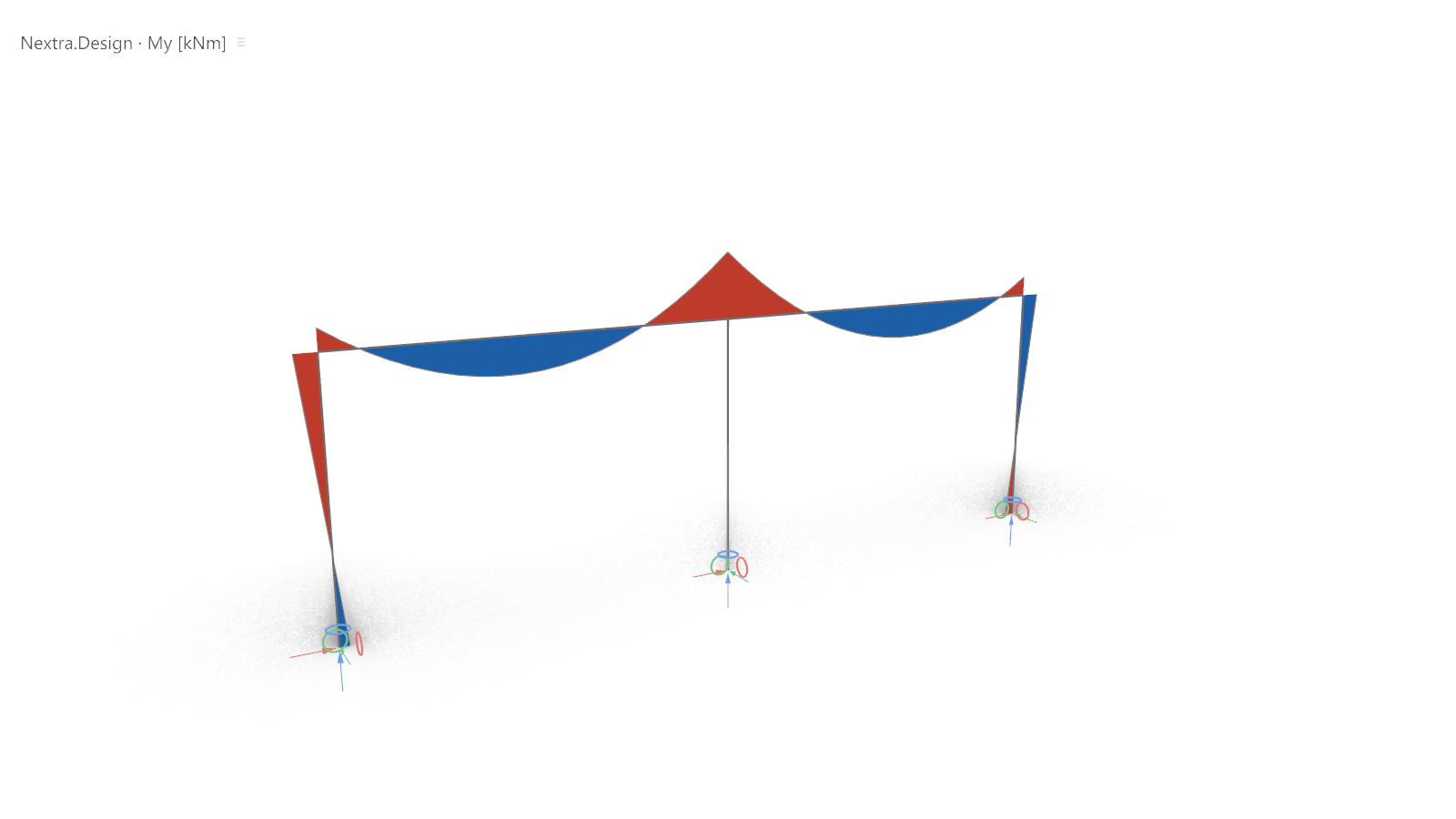
The bending moment runs on over the middle column, where the Grasshopper bay meets the Rhino bay: the two parts really are one frame.
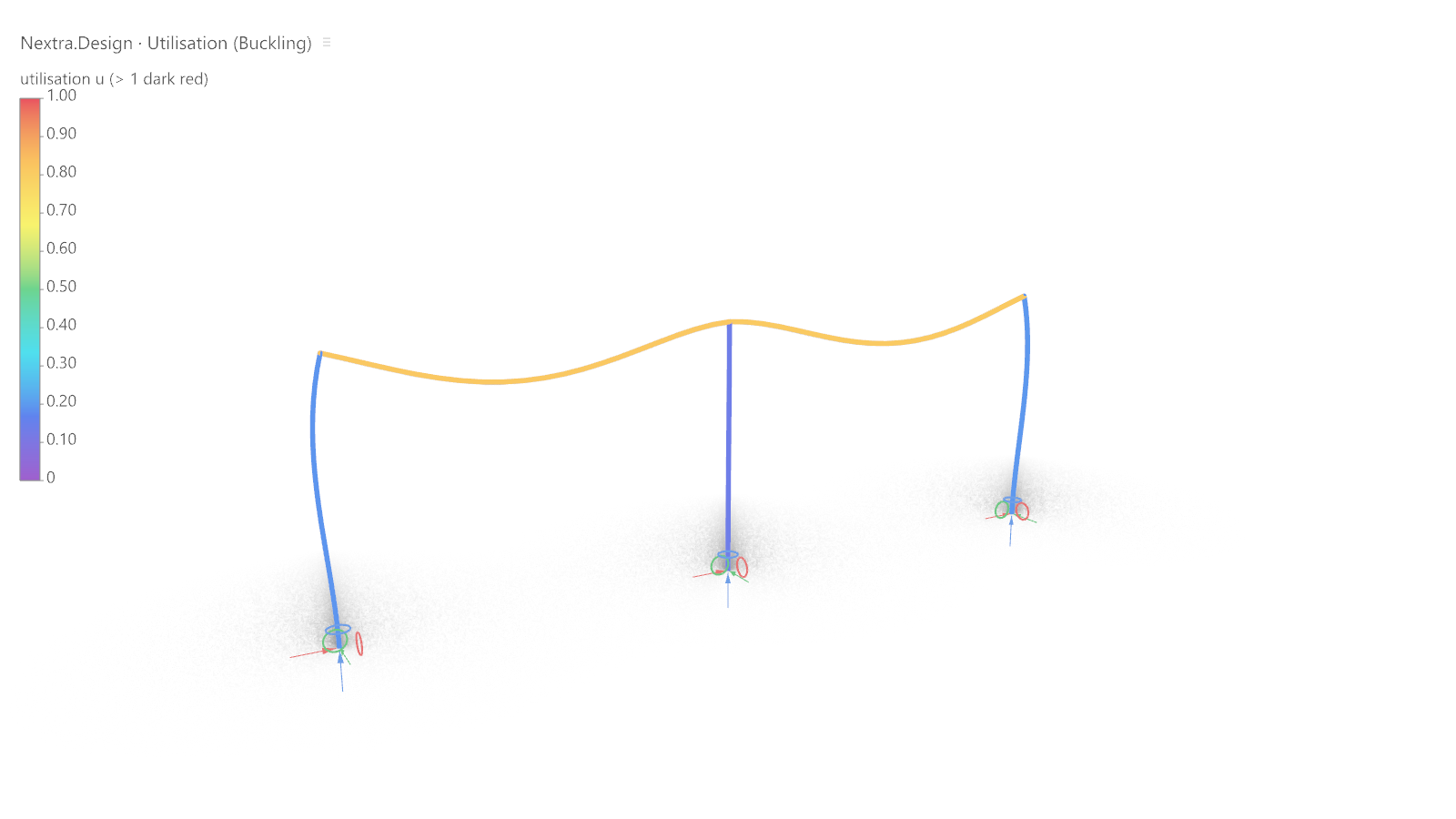
Both beams come out at u 0.81 (buckling with LTB, the Grasshopper beam 0.815, the Rhino beam 0.808), the columns at 0.13 to 0.20.
A bigger example, a steel hall with Rhino columns and a parametric Grasshopper roof truss, is in Rhino for what is fixed, Grasshopper for what changes.
#"Show me ..." - the AI drives the panel
The AI can also choose what you see: a result as a diagram or a contour, the deformed shape, the values at the ends, or a design check from the Design tab. And it finds a setting for you.
- Show the bending moment My as a member diagram, with the values at the ends and the middle.
- Now show the buckling utilisation as a contour on the deformed shape.
- Where do I change the size of the legend? - the panel opens Display > Legend size and highlights it.
The two pictures of the two-bay frame above were set up this way: the AI chose My as a diagram, then the buckling check as a contour on the deformed shape.
Choosing the result, style and shape from the AI needs Nextra Design 0.1.0-beta.17; finding and showing settings works now.
#Tested with a small model
We gave the skill to a small, fast model (Claude Haiku) with nothing else: no hints, only the request. Four cases: the timber beam in Rhino, the portal in Grasshopper, the two-bay frame in Both, and the panel. With the skill as it is now, all four give the right answer, in 11 to 26 tool calls. The Both frame and the panel were right the first time; the beam and the portal first went wrong, and those runs are why the skill got better.
Where a small model went wrong, and what the skill now does about it:
- It wrote a second load in a way an older plug-in refused without an error, and reported a utilisation half the real one. The skill now writes every attribute so it works on every version, reads it back, and checks the answer with one line of hand calculation before reporting.
- In Grasshopper it wired two loads so that the beam entered the model twice, each copy taking part of the load. The skill now shows the right wiring, and Nextra Design warns when one element arrives twice.
- In Both it used a different load case name on each side, which makes two separate imposed loads. The skill now reads the Grasshopper case names first and uses the same ones.
#Careful with tokens
Every step costs tokens, and pictures cost the most. The skill tells the AI to search before reading, to read one to three short pages, to ask Rhino for small answers (the few numbers it needs, never a whole results file) and to take a picture only when you need to see something. In the tests a whole case, reading the skill included, stayed between 56,000 and 84,000 tokens.